



What Are Deep C Floor Systems?
Deep C floor systems are a type of cold-formed steel flooring that uses C-shaped joists with pre-engineered service openings to integrate structure and building services within the same floor depth. They are widely used in modular and mid-rise construction because they improve ease of construction, reduce part count and support faster, more consistent installation compared to traditional trussed (lattice or webbed) CFS floor systems.
Deep C floor cassette showing multiple system components
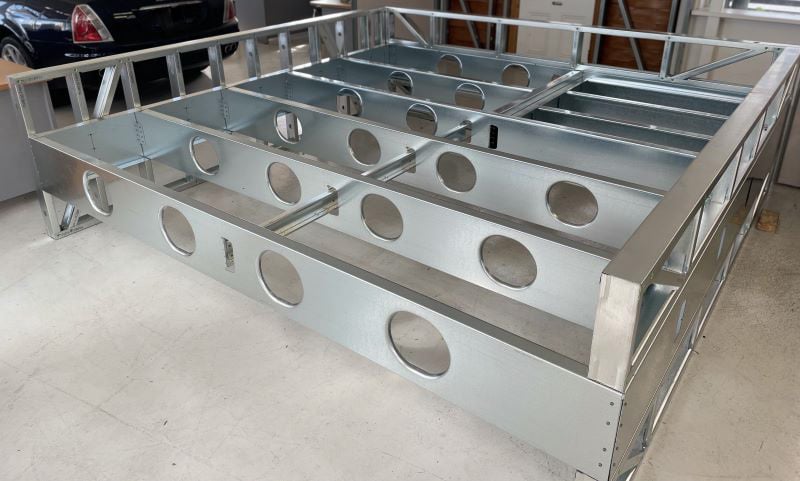
Floor systems are often discussed in terms of span and load alone. In my view, that is too narrow. The real question is not simply whether a floor works structurally, but whether it can be detailed, manufactured and assembled consistently enough to support faster and more predictable construction towards a holistic solution.
Cold-formed steel (CFS) has long been recognized as a suitable material for floor construction. I have seen earlier industrial guidance identify floors as one of the more practical applications for cold-formed steel because of dimensional consistency, reduced weight, cut-to-length supply and the ability to incorporate pre-formed service openings. The same guidance also noted that cold-formed steel framing is code-recognized in applications extending into multi-story construction.
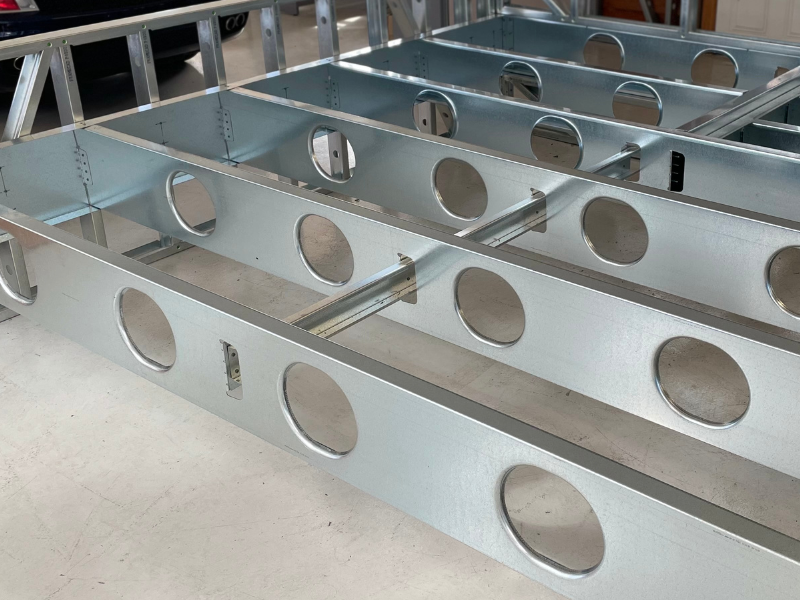
Within that wider context, deep C floor systems are increasingly relevant. These systems use roll-formed C-shaped joists, typically combined with rim tracks or channels, sheathing and a defined connection strategy. In more developed arrangements, they may also include large, stiffened service holes, tabbed connections and boxable member options. Their importance lies in their relative simplicity. Instead of creating an open trussed floor from many smaller elements, the floor is resolved through fewer primary members, with service integration and detailing addressed within the joist system itself.
Deep C joists connected to end bearers using a pre-punched tab connection
Why Deep C Floor Systems Matter
The main technical challenge in light steel flooring has not been gravity strength alone. In my experience, it has been service integration, particularly those that arise at the site. Conventional cold-formed steel joists can accommodate wiring and smaller plumbing runs, but larger ducts and waste pipes have historically been more difficult to route through the floor depth. That issue has been identified in the research literature as one of the main barriers to wider use of cold-formed steel joists in floor construction.
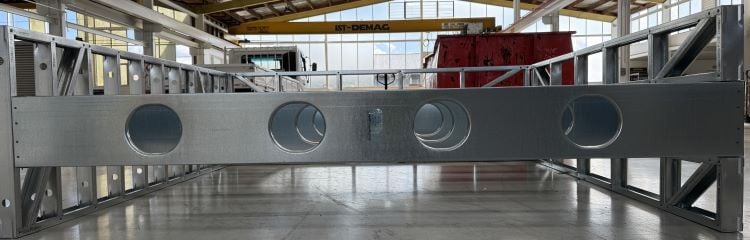
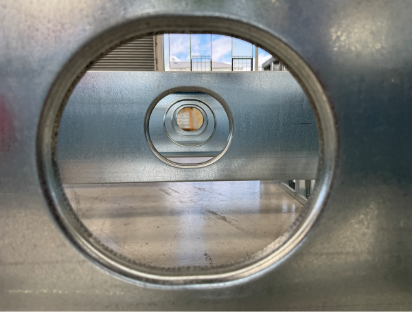
That is where deep C floor systems with pre-engineered web service holes become more attractive. By using larger pre-formed openings, particularly stiffened openings, they make better use of the structural depth of the floor. The aim is not simply to add holes to a joist, but to integrate structure and services within the same floor zone in a way that remains structurally credible. This is especially important in modular and mid-rise buildings, where floor depth, coordination and repeatability all affect program and cost.
Pre-engineered stiffened web service holes engineered and produced using FRAMECAD technology
 |
 |
A related diaphragm study is also relevant because it shifts the discussion from joists to the floor assembly as a whole. Once sheathing is fixed to cold-formed steel joists, the floor acts as a horizontal diaphragm, with performance depending not only on the joists but also on the sheathing, fasteners and edge members. That systems view matters in mid-rise work, where the floor contributes to both gravity and in-plane structural behavior.
Buildability and Speed
The appeal of deep C floor systems is not only structural. In my experience, it is mainly tied to the ease of construction. Where a floor can be formed from fewer primary members, with service holes and connection features already incorporated, the assembly process becomes more direct. Contemporary technical manuals for deep C systems show this clearly through pre-punched service holes, joist-to-rim attachment options, boxing arrangements, and member ranges tailored to different project demands.
This matters particularly in modular and panelized construction. I see repetition reward systems that minimize part count, reduce site adjustment and bring more of the decision-making into the design and manufacture stages. A floor system that arrives with defined service locations, connection geometry and member lengths already resolved is easier to install consistently than one that relies on a higher degree of site-led interpretation. Deep C floors are attractive where timelines matter.
Manufacturing also plays an important role. Roll-formed systems lend themselves to precise, repeatable production and project-specific detailing in ways that are difficult to achieve with less integrated approaches. In practice, this means the benefits of deep C flooring are strongest when structural design, detailing and fabrication are aligned rather than treated as separate tasks.
Deep C Joists and Lattice Joists
A short comparison with lattice joists is useful, provided it is kept in proportion. Lattice joists, also known as webbed joists, solve the service problem through openness. Their trussed form creates a naturally accessible zone for ducts, pipes and cables. That can be advantageous where service routing is the dominant requirement or where a more open floor configuration is desirable. However, to satisfy specific strength requirements, this system may sometimes need localized member reinforcement, such as adding extra members to the chords or installing local plates at weaker web-chord connections. These enhancements will require additional site labor, which in turn may increase the project's total cost and delivery time.
Trussed flooring joists
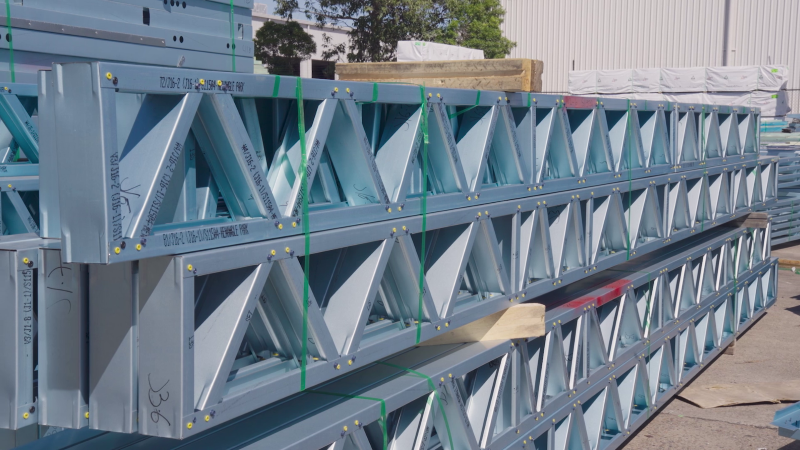
Deep C floor systems solve the same problem differently. They retain a simpler primary member form and recover service functionality through engineered openings and integrated detailing. The distinction is therefore not one of right and wrong, but of system logic. Lattice joists create access through an open truss. Deep C systems create access by making the joist more functional since it’s shallower, or with the use of pre-engineered holes.
In conventional construction, stacking and transportation are more advantageous for Deep C systems compared to webbed joists for equivalent applications. Deep C systems typically require significantly less space than webbed joists.
That distinction has practical consequences. I find lattice joists may be advantageous where service access is the dominant design driver. Deep C systems may offer a clearer route where speed, repeatability, reduced part count and design-to-manufacture integration are more important. The choice depends less on preference than on the dominant project constraint.
Where Deep C Floor Systems Fit Best
Deep C floor systems in cold-formed steel are particularly well suited to projects where coordination and repetition are central. I see this in modular buildings, panelized systems, hotels, apartments, facade systems and other mid-rise applications where the floor must be installed quickly, integrate building services efficiently and work within a controlled manufacturing environment.
They are also well suited to projects where floor depth must work harder. Large, stiffened service holes allow more of the MEP distribution to be brought within the structural zone with minimal impact to the structural integrity compared to unstiffened holes. Tabbed and boxed options help the system adapt to perimeter and connection demands with less dependency on third-party connection systems. Sheathing and fastener design then complete the assembly as a structural diaphragm rather than a set of isolated members.
Conclusion
Deep C floor systems in cold-formed steel should be understood as a system choice rather than merely a profile choice. In my view, its value lies in the combination of structural efficiency, service integration, repeatable manufacture, and reduced assembly complexity. The strongest case for it is not that it replaces every other floor type, but that it addresses a recurring set of project pressures more directly: faster installation, better coordination of services and stronger alignment between engineering, manufacturing and installation.
Set against lattice joists, I believe the comparison is best framed in terms of application rather than preference. Lattice systems create openness through truss geometry. Deep C systems pursue ease of construction and serviceability through engineered openings and more integrated detailing. In modular and mid-rise construction, that makes deep C flooring a credible and practical solution.
Frequently Asked Questions About Deep C Floor Systems
What is a Deep C floor system?
A Deep C floor system uses cold-formed steel C-shaped joists with pre-engineered openings to allow services such as ducts and pipes to pass through the structural depth, improving coordination and efficiency.
How do Deep C joists differ from lattice joists?
Deep C joists integrate services through engineered openings in a solid web, while lattice (webbed) joists provide open spaces between members. Deep C systems prioritize simplicity and repeatability, while lattice joists prioritize open access and flexibility to be deeper.
Why are Deep C floor systems used in modular construction?
They reduce part count, allow for pre-defined service routes and support consistent, repeatable assembly key advantages in offsite and modular construction.
Can Deep C floor systems handle building services like ducts and pipes?
Yes. Large, stiffened service openings are designed into the joists to accommodate MEP services within the floor zone without compromising structural performance.
Are Deep C floor systems suitable for multi-story buildings?
Yes. Cold-formed steel framing, including Deep C systems, is widely used and code-recognized for mid-rise and multi-story construction.
What are the main benefits of Deep C flooring?
Improved buildability, faster installation and production, coordinated service integration, reduced on-site adjustments, and alignment between design, manufacturing and construction.